AI-Powered SEO Content Generation and Multi-Platform Distribution Tool
Developer Tools
I. Core Product Positioning and Value Proposition
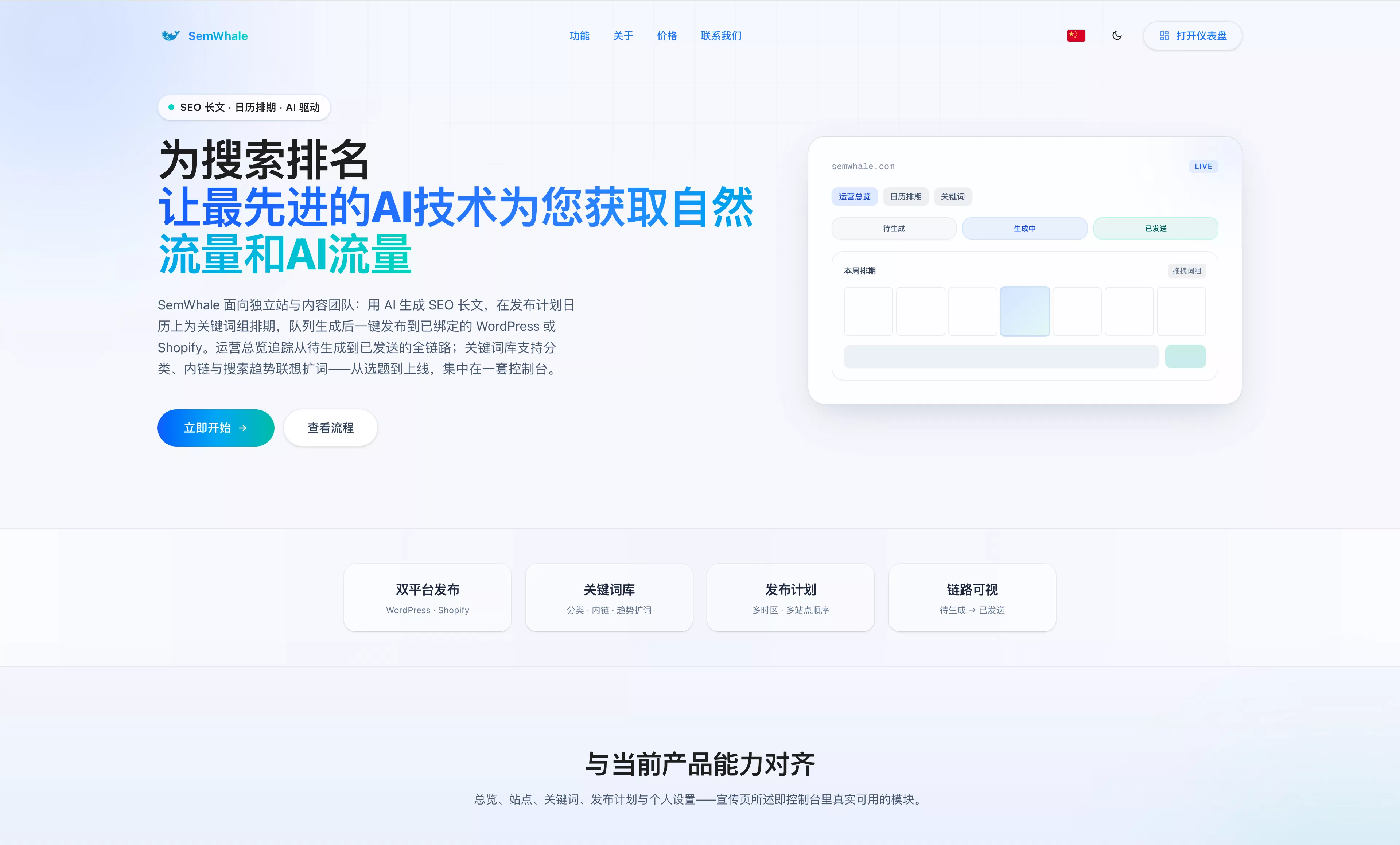
SemWhale is positioned as an "AI-driven SEO content generation and multi-platform distribution operating system". Its value proposition is very clear:
- Core Objective: Help indie stores and content teams systematically acquire organic search traffic and AI traffic.
- Core Means: Integrating AI content production, SEO strategy, cross-platform publishing, and full-process observability into a unified console.
- Core Philosophy: Emphasizing "observability" and "process-oriented" approach, replacing the "guesswork" and "invisibility" of traditional content marketing with clear dashboards and status tracking, ensuring teams can "consistently deliver content".
II. Target User Personas
- Independent E-commerce Sellers/Brands: Using platforms like Shopify, lacking professional content teams, but deeply aware of the importance of SEO and content marketing for driving traffic to independent sites.
- Small-to-Medium Content Teams/Marketing Agencies: Need to efficiently produce, schedule, and publish SEO content for multiple clients or projects, managing complex publishing calendars and keyword matrices.
- Growth-oriented Individuals or Small Teams: Highly receptive to AI tools, needing an "all-in-one" solution to take over the entire chain of work from content ideation to launch, to improve individual productivity.
III. Product Architecture and Core Workflow Analysis
The product design centers around a clear "four-step closed loop" workflow, embodying its "operating system" philosophy:
1. Infrastructure Layer: Connection and Configuration
- Site Management: Supports WordPress and Shopify as the two core platforms, achieving secure connections via App Password or API Token. This captures the two most important battlegrounds for content marketing and independent site e-commerce.
- Publishing Schedule: Supports multi-plan, multi-timezone, and daily runtime configurations, with the ability to set publishing intervals between different sites. This satisfies professional teams' need for fine-grained control over global, cross-project publishing rhythms.
2. Strategy and Material Layer: Keyword Library
- This is not a simple keyword list, but rather a strategy center.
- Categorized Management: Structurally organizes keyword groups for easy planning and reuse.
- Trend-based Expansion: Recommends related keywords based on trend data, helping content strategy dynamically optimize—a highlight that differentiates it from static keyword tools.
- Internal Linking: Supports preset anchor text and links, automatically inserted during article generation. This feature integrates on-site SEO optimization directly into the production workflow, greatly improving efficiency for advanced SEO work.
3. Scheduling and Execution Layer: Calendar and AI Generation
- Visual Calendar: Supports direct drag-and-drop of keyword groups for scheduling, turning abstract plans into concrete visuals and reducing management costs.
- Queued Generation: AI generation tasks enter a queue and are processed asynchronously, freeing users from waiting.
- Content Testing and Iteration: Provides "article test generation" functionality for advanced users, allowing repeated debugging of generation prompts to optimize content quality. This caters to advanced users' need for "controllability" and "customization."
4. Observation and Operations Layer: Operations Overview
- Full Pipeline Status Tracking: From "pending," "generating," "ready" to "sent," every content status is clearly visible at a glance. This is the direct embodiment of the "observability" philosophy.
- Failure Alerts: Displays recent failed tasks, allowing operations personnel to prioritize problem resolution and ensure process stability.
- Trend Overview: The 7-day trend chart provides simple data feedback, helping evaluate output rhythms.
IV. Technical Implementation and AI Application Depth
- Deep AI Integration: AI does not play a role only in the generation phase. It is closely integrated with keyword trend analysis, internal link insertion, and even cover image generation (WordPress featured images/Shopify headers), forming an AI-powered content production line.
- Rich Text/HTML Editing: After AI generation, space is retained for manual editing and polishing, balancing AI efficiency with human quality control.
- Unified Pipeline: Both "article test generation" and formal generation use the same pipeline, ensuring consistency between test results and final output, avoiding the common problem of "effective testing, different production results."
V. Business Model Analysis
- Current Model: Offers both "free trial" and "monthly subscription" models.
- Free Plan: Limited features, but provides a complete, time-limited (1 day) full-featured experience—an efficient customer acquisition tool.
- Paid Plan: Priced at 588 CNY/month, with core unlocks of "unlimited generation" and "up to 30 sites." This pricing targets small commercial teams or agencies with stable production needs managing multiple websites, placing it in the mid-range SaaS tool segment.
- Sales Strategy: The paid plan is labeled "Contact Sales / Early Access," suggesting it may adopt a hybrid model of self-service subscription + proactive sales, or is currently in an early stage of targeted invitation, facilitating the collection of in-depth user feedback.
VI. Market Competition and Differentiated Advantages
- Market Positioning: Found a precise vertical niche between "general AI writing tools" and "heavyweight SEO suites": SEO long-form content production and distribution automation.
- Core Advantages:
- Workflow Closed Loop: From planning, production, and scheduling to publishing and monitoring, forming an end-to-end complete solution that reduces users' friction of switching between multiple tools.
- Deep Platform Integration: Publishing support for WordPress and Shopify goes beyond simple API calls, but considers details like featured images and publishing order—more "native."
- Emphasis on "Operations" Perspective: The operations overview dashboard is key to differentiation from most marketing tools; it serves "content operations stability," not just "content creation."
- Focus on E-commerce and Independent Sites: Explicitly serving "Indie Stores," its feature design (such as Shopify support, internal links serving conversion) is more aligned with the actual needs of this group.
VII. Potential Challenges and Development Recommendations
-
Challenges:
- Market Education: Needs to prove to target users that this "operating system" is more efficient and reliable than combining multiple point tools (such as ChatGPT + Ahrefs + manual publishing).
- Content Quality Ceiling: The quality and uniqueness of AI-generated content remains a core challenge, requiring continuous optimization of models and prompt frameworks.
- Competition: May face competitive pressure from general writing tools integrating workflows downward, or large SEO platforms integrating AI generation features upward.
-
Development Recommendations:
- Deepen AIGC Capabilities: In the future, explore multimodal generation (combining images, infographics), video script generation, and differentiated content suggestions based on competitor analysis.
- Expand Distribution Channels: On the basis of consolidating WordPress and Shopify, consider adding distribution support for content platforms like Medium, Substack, and Ghost, or social media like LinkedIn and Twitter.
- Strengthen Data Analysis Closed Loop: The current "trends" feature is relatively simple. In the future, deeply integrate Google Analytics or Google Search Console data to provide "content performance retrospectives," using actual ranking and traffic data to guide keyword library optimization and content strategy adjustments, truly achieving an "intelligent closed loop."
- Collaboration Features: For the "content team" positioning, add collaboration features such as manuscript review, annotations, and multi-role permission management.
Summary: SemWhale is a SaaS product with clear design thinking and complete architecture. It has successfully engineered AI capabilities into a manageable, observable business process, precisely hitting the pain points of independent sites and content teams in scaled content production and distribution. Its key to success lies in continuously optimizing AI output quality and building a more powerful feedback and optimization closed loop around the core of "data-driven SEO content operations."