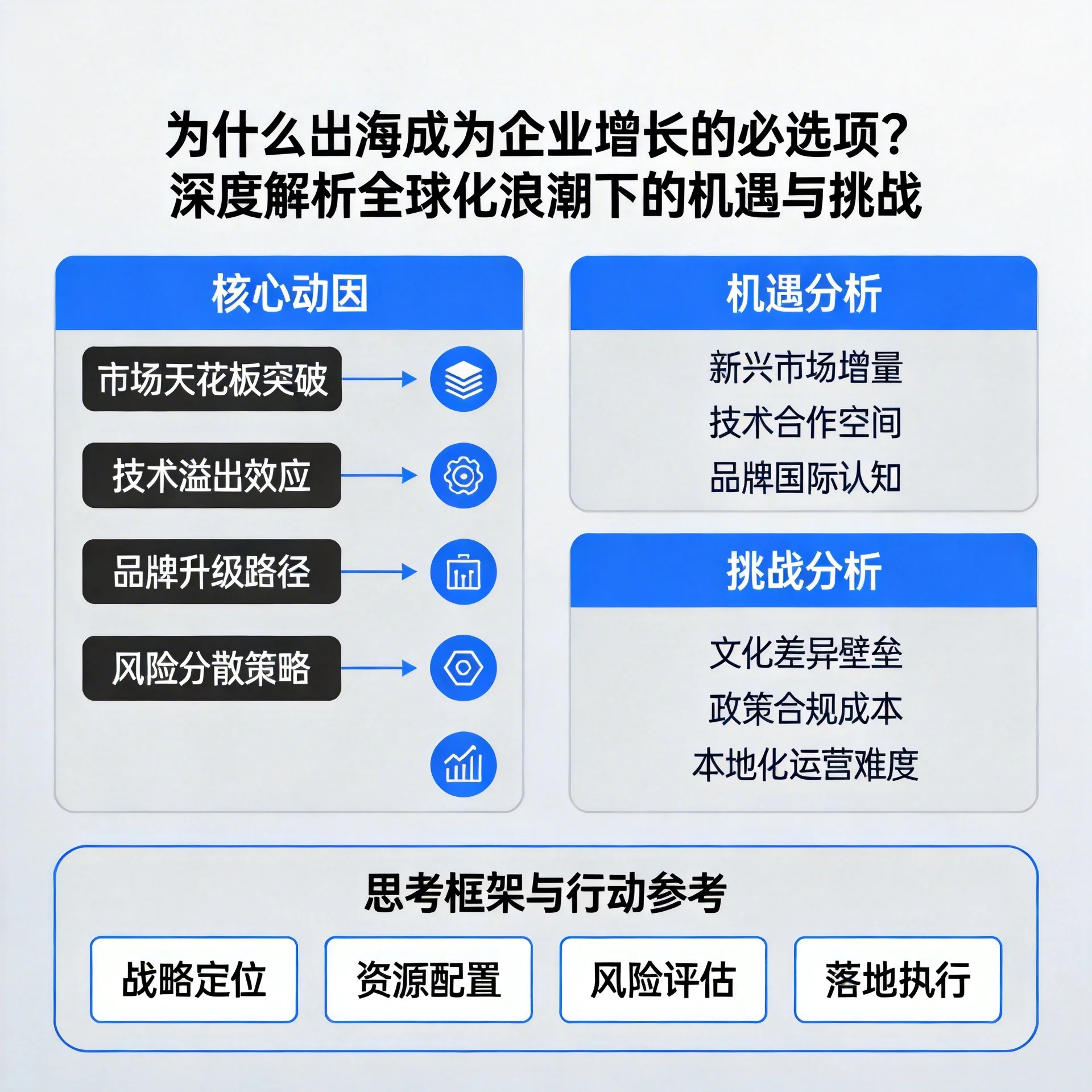
Why Has Going Global Become a Mandatory Choice for Corporate Growth?
As competition in the domestic market intensifies into a red ocean and the marginal effects of growth diminish, looking towards the broader global market is no longer the exclusive domain of a few giants. It has become a common choice for an increasing number of enterprises seeking breakthroughs and growth. Going global is evolving from an "option" into a "mandatory choice" concerning future survival and development.
Introduction: The Era's Shift from "Involution" to "External Expansion"
There was a time when "going global" was a term reserved for manufacturing giants like Huawei, Haier, and Lenovo. Today, from ByteDance's TikTok captivating the world to SHEIN conquering Gen Z in Europe and America with fast fashion, to countless SaaS companies, game developers, consumer brands, and content creators setting their sights overseas, an unprecedented wave of "global expansion" is sweeping through China's business world. Behind this trend lies not a fleeting fad, but an inevitable strategic choice driven by the convergence of multiple epochal factors.
I. Core Driving Forces: Why Go Global?
1. Breaking Through the Domestic Market Ceiling, Finding the Second Growth Curve
For many industries, market penetration in China is nearing saturation, incremental space is narrowing, and competition has entered a fiercely "involuted" state. Going global means opening up a new market with billions of potential users. Emerging markets like Southeast Asia, the Middle East, Latin America, and Africa have young populations, rapidly increasing internet penetration, and immense consumption potential, offering enterprises a vast "blue ocean" space.
2. The "Spillover Effect" of Technology, Models, and Supply Chain Capabilities
Tempered by fierce competition in China's mobile internet and manufacturing sectors, Chinese companies have accumulated world-class competitiveness in areas like digital operations, agile supply chains, user experience design, and business model innovation. This capability for "dimensional reduction strikes" provides a significant advantage in many overseas markets. Localizing and adapting domestically proven models often leads to unexpected success.
3. Enhancing Brand Value and Risk Resilience
The fate of a company operating in a single market is deeply tied to the local economic and policy environment. A global footprint effectively disperses risks related to geopolitics, economic cycles, and industry fluctuations. Furthermore, becoming a successful international brand can significantly enhance a company's brand premium, talent attractiveness, and valuation in the capital markets, creating a powerful virtuous cycle.
4. Leveraging Global Resources and the Innovation Ecosystem
Going global is not just about selling products; it's about integrating global resources. Companies can leverage overseas talent, technology, capital, and creativity to feed back into domestic operations, achieving genuine global innovation. Examples include setting up R&D centers in Silicon Valley to capture cutting-edge technology or sourcing design talent in Europe to enhance product aesthetics.
II. Going Global is No Longer a "Choice," but a "Question of Survival"
- Globalized Competition: Even if you don't go out, foreign competitors may come in. Taking the initiative to build moats on a broader battlefield is an active defense strategy.
- Globalized Customers: Your target customers may themselves be globally mobile, or their needs may be influenced by global trends. Serving a global customer base is essential for deeply understanding needs and maintaining product foresight.
- Globalized Capital: International capital favors companies with a global narrative and potential. A global expansion strategy can significantly broaden financing channels and secure better valuations.
III. Challenges and Key Success Factors in Going Global
The opportunities are vast, but the path is far from smooth. Companies expanding overseas must squarely face the following challenges:
- Cultural Differences and Localization Pitfalls: From language, aesthetics, and consumption habits to religious beliefs and laws/regulations, deep localization is a matter of survival. Blindly copying domestic models is doomed to fail.
- High Barriers of Compliance and Data Security: Regulations like GDPR, various foreign investment reviews, and cross-border data flow rules form a complex compliance web. Compliance costs are a crucial investment that must be budgeted for.
- Global Upgrade of Organizational and Management Capabilities: How to build cross-cultural teams? How to implement remote collaboration? How to design an organizational structure that balances global efficiency with local flexibility? This places extremely high demands on a company's management capabilities.
- Fierce International Competition: You will face dual competition from global giants and local incumbents, requiring a unique, differentiated positioning.
Key success factors can be summarized as:
- Product Strength is the Foundation: Possessing products or services that genuinely solve user pain points and are internationally competitive.
- Localization is the Soul: Building local teams, deeply understanding the market, and creating products and operations that are "born local."
- Compliance is the Bottom Line: Treating compliance as a strategic priority, establishing a professional legal and risk control system from day one.
- Patience and Long-termism: Cultivating overseas markets takes time. Avoid short-termism; the domestic mindset of "burning money for growth" may not translate well.
IV. Path Choices for Different Companies Going Global
- Product/Service Export: Directly launching or adapting mature domestic products (e.g., apps, SaaS, hardware) for overseas markets.
- Brand Export: Establishing a proprietary brand through cross-border e-commerce (e.g., Amazon, DTC websites) or offline channels.
- Technology/Model Export: Licensing or empowering overseas partners with technological solutions or business models.
- Capital Export: Rapidly acquiring markets, technology, and teams through investments or mergers and acquisitions of overseas companies.
Companies should choose the most suitable "global expansion portfolio" based on their own resources, capabilities, and strategic goals.
Conclusion: Embracing the "Glocal" Era, Building Borderless Enterprises
Going global is not the end goal but a means to achieve sustainable growth. It tests a company's comprehensive strength: the global adaptability of its products, the cross-cultural resilience of its organization, and the long-term strategic fortitude.
The future winners will be those enterprises that deeply understand the essence of "Glocal" (Global + Local)—possessing both a global vision and perspective, while also taking root in each local market, becoming truly "borderless enterprises."
For every entrepreneur and manager, the question is no longer "whether to go global," but "when to go global" and "how to succeed globally." This expedition towards the world, though fraught with thorns, holds opportunities and glory at its end worthy of the全力以赴 efforts of all ambitious enterprises.
The world is flat, but opportunities are not evenly distributed. Only those who proactively step into the world have the chance to redistribute them.