Introduction: From "Machines Taking Jobs" to "AI as a Great Partner"
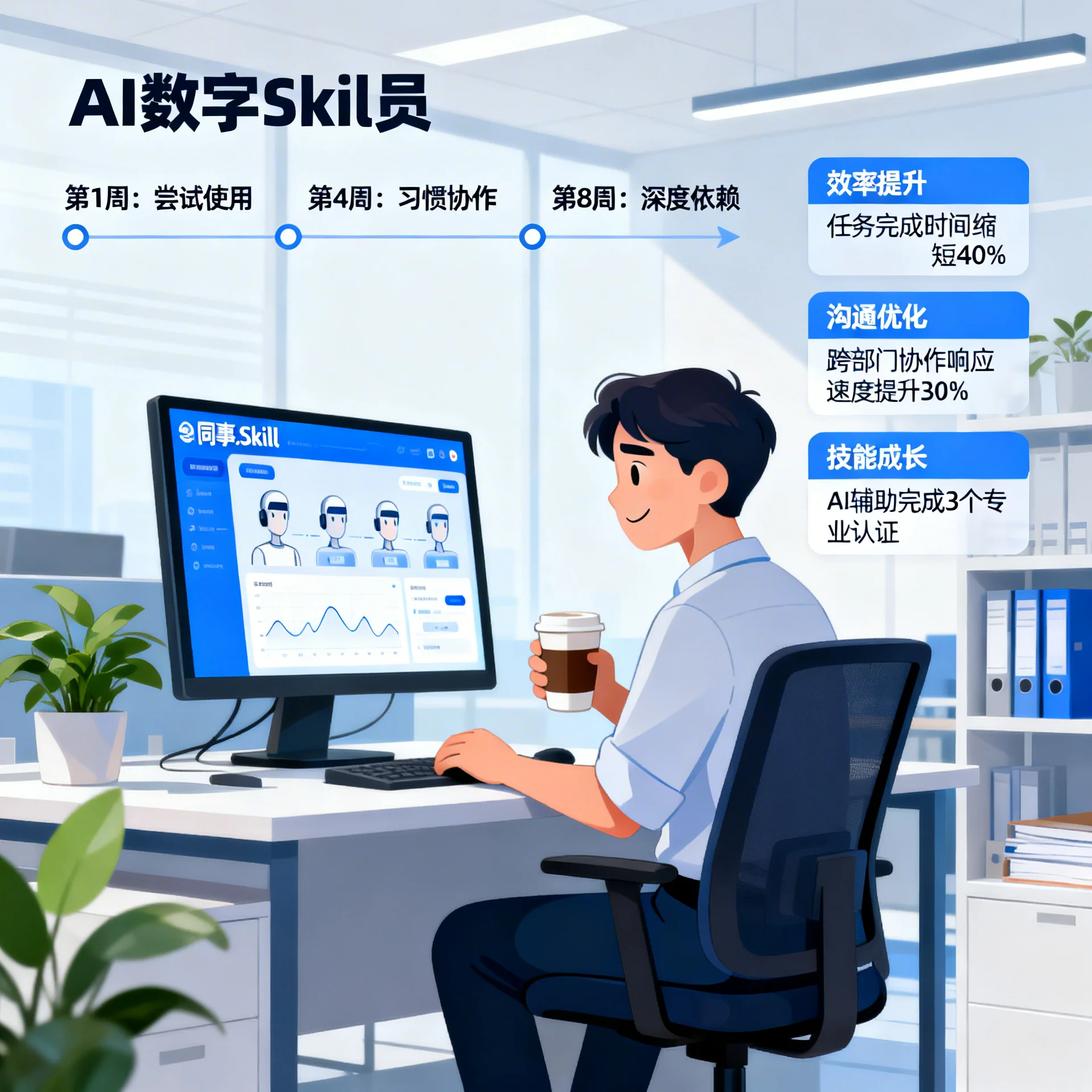
Three years ago, if someone had told me "your colleague will be an AI," I would have laughed and shaken my head, thinking "this must be a joke." Back then, discussions about artificial intelligence were still stuck in the anxiety of "which professions will AI replace." But today, when I open my computer every day and see the digital assistant called "Colleague.Skill" in our work group handling various tasks methodically, I realize: AI didn't come to take our jobs, but to be our best partner.
Today, I want to share my story with "Colleague.Skill" from the perspective of an ordinary employee—how it went from being a "stranger" to an "indispensable colleague."
First Encounter: From Observation to Trial
I remember the first time I encountered "Colleague.Skill" was when our company introduced this AI collaboration system last year. To be honest, my mindset back then was complex: on one hand, I was curious about the new technology; on the other hand, I worried about whether I would be "optimized out."
This kind of psychology is probably understandable to many workplace professionals. We're accustomed to collaborating with other people, so suddenly having to work with an "invisible and intangible" AI can inevitably feel uncomfortable. But after actually getting hands-on with it, I discovered that "Colleague.Skill" was much more "intelligent" and "friendly" than I had imagined.
It's not a cold tool, but a partner who truly understands collaboration.
Daily Work: Visible Efficiency Improvements
A Revolution in Document Processing
In the past, writing a project report required me to dig through various materials, emails, and meeting notes for half a day. Now, I just need to describe my needs to "Colleague.Skill," and it can help me quickly organize a report framework, and even automatically generate a draft that matches my work style based on my habits.
This doesn't mean I've become lazy—on the contrary, I have more time to do work that really requires thinking: analyzing data, providing insights, and formulating strategies. AI helps me handle the tedious information organization work, while the core value judgments remain in my hands.
Meeting Notes Are No Longer a Headache
Meetings are one of the most time-consuming aspects of office work for professionals, and meeting notes give many people headaches. Ever since having "Colleague.Skill," after each meeting, a well-structured and clearly-pointed summary is already prepared. It can not only accurately record the key points of each person's speech, but also automatically mark action items and responsible parties.
I no longer have to spend half an hour after a meeting filling in those vague memories of "I think he mentioned something about..."
Email and Message Management
Processing hundreds of emails and messages every day is a daily routine for many professionals. "Colleague.Skill" can help me intelligently categorize email priorities, extract key information, and even help me draft reply content. For issues requiring multi-department coordination, it can also quickly help me organize communication points, making cross-department collaboration smoother.
Skill Growth: AI as a Mirror and a Mentor
After using "Colleague.Skill," my biggest feeling is: it feels like a mirror, allowing me to see my strengths and weaknesses more clearly.
For example, when I need to complete a data analysis report, "Colleague.Skill" can quickly provide multiple analytical frameworks, which made me realize: the same problem can have so many different angles of approach. By comparing AI's solutions with my own thinking, I can more objectively evaluate my thinking patterns.
What's even better is that when I'm unfamiliar with a certain field, "Colleague.Skill" can serve as my "instant mentor." It can recommend relevant learning resources based on my questions and explain complex concepts in ways I can understand. This always-available "one-on-one tutoring" is hard to achieve with traditional learning methods.
Human-Machine Collaboration: Finding the Optimal Balance
Of course, AI collaboration doesn't mean completely relying on AI. In my practice over this period, I've also summarized some insights:
Areas where AI excels:
- Tasks that are highly repetitive with clear rules
- Information retrieval and organization
- Draft generation and format optimization
- Quick answers to basic questions
Areas requiring human oversight:
- Strategic decisions and direction control
- Complex interpersonal communication and negotiation
- Creative thinking and breakthroughs
- Emotional judgment and value trade-offs
The optimal work model is: let AI handle those tasks that are "time-consuming but don't require much brainpower," freeing up more energy for yourself to focus on what truly matters. This isn't being lazy; it's working smarter.
Mindset Shift: From Fear to Embrace
Looking back on the mindset changes throughout this journey, I've summarized several stages:
Stage One: Observation and Doubt—"Is this thing reliable? Don't mess up my work."
Stage Two: Trial and Exploration—"Let me try it first, it's not a big deal if there's an error."
Stage Three: Dependence and Trust—"This is really useful, I can't live without it now."
Stage Four: Balance and Coexistence—"I know where its boundaries are, and we work well together."
Now, I've completely accepted this "digital colleague." It's not a threat, but an assistant; not a competitor, but a collaborator.
Some Advice for Fellow Professionals
If your company is also introducing similar AI collaboration tools, or if you're considering how to better collaborate with AI, I have a few suggestions:
1. Keep an Open Mind Don't resist trying because you're unfamiliar with AI. New technology always brings discomfort, but only by embracing change can you avoid being eliminated by the times.
2. Start Small Don't think about using AI to accomplish all your work right from the start. Begin with a small task, like using AI to help write emails or organize documents, and gradually expand the scope of use once you're familiar with it.
3. Learn to Ask Questions The key to collaborating with AI lies in "knowing how to ask questions." The more specific and clearer your instructions, the more satisfying the results you'll get. This also cultivates your own logical thinking ability.
4. Maintain Critical Thinking AI can make mistakes and has blind spots. Always maintain independent thinking and conduct necessary review and adjustment of AI's output.
5. Use It as a Growth Tool Don't just treat AI as a "task-doing tool," but also as a learning partner. Through collaboration with AI, continuously expand your capability boundaries.
Conclusion: The Future Is Here, Win Through Collaboration
Looking back from the time point of 2024, AI is no longer a distant concept but a reality happening around every professional. What "Colleague.Skill" represents is not only technological progress but also the beginning of an entirely new way of working.
As ordinary employees, we may not be able to determine the direction of AI technology development, but we can choose how to coexist with AI. Instead of worrying about being replaced, let's think about how to leverage AI's power to maximize our own value.
Remember: No matter how powerful AI becomes, it's still a tool; and the one who truly creates value is always human.
So, don't be afraid of your AI colleague. Open your heart, extend your hands, and welcome this new partner!
Maybe one day, just like me, you'll sincerely say: "It's so good to have it."