Introduction
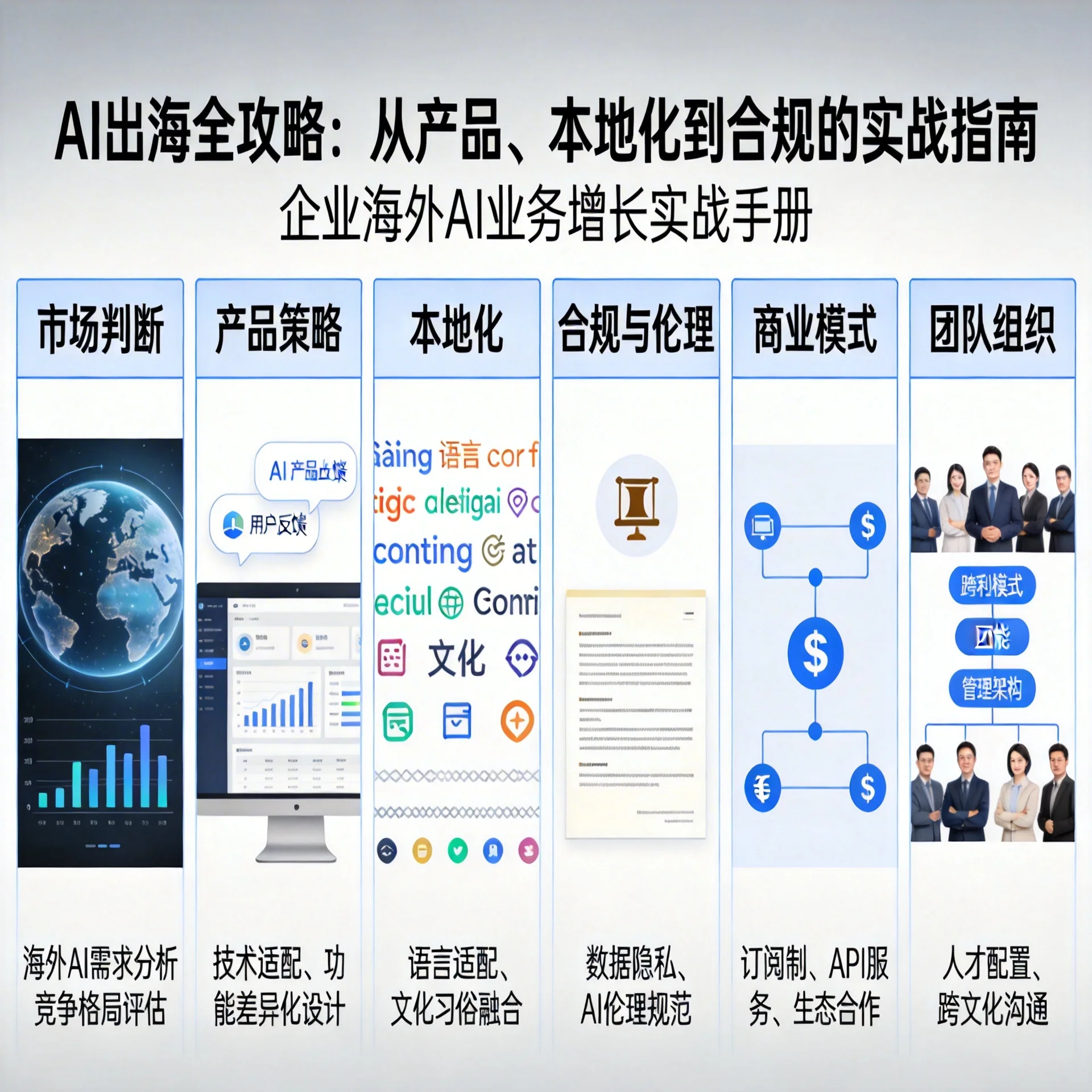
As artificial intelligence moves from research to commercial deployment, it brings new opportunities and challenges for software and service internationalization. Compared with traditional overseas expansion, AI products involve multidimensional factors such as data, models, privacy, and compliance. Success depends on coordination among technology, operations, and localization strategies. This article is aimed at founders, product managers, and decision-makers, and systematically outlines the key points and practical directions for AI going global to help you build a sustainable globalization path.
Why choose AI going global
- Market opportunity: Many countries have strong demand for intelligent services, and early entry can establish a first-mover advantage.
- Technical barriers: Mature models and data capabilities can form a high moat.
- Cost and scale: Overseas markets can bring a larger pool of paying users and higher unit prices.
At the same time, be aware that differentiated needs, regulatory constraints, and infrastructure differences will amplify product design complexity.
Product strategy: from core capabilities to differentiation
- Clarify core capabilities: Focus first on one or two replicable technologies or application scenarios (such as intelligent customer service, text-to-image, speech recognition), and avoid blind multi-front expansion.
- Design lightweight entry points: Prioritize validating market demand with a simple user experience, and iterate rapidly via APIs or lightweight clients.
- Data strategy: Plan data collection, annotation, and incremental training workflows in advance to ensure models can continuously adapt to local language contexts and industry practices.
Localization: deep adaptation beyond translation
Localization is not just language translation; it also includes adapting to culture, interaction habits, payment methods, and legal environments. Key practices include:
- Corpus localization: Collect and clean local corpora for fine-tuning models or adjusting retrieval strategies.
- Experience localization: Adjust interfaces, conversational style, and result presentation according to user habits.
- Payments and billing: Integrate local mainstream payment channels and design payment flows and trial policies that match local habits.
Compliance and ethics: non-negotiable bottom lines
Regulations on data privacy and AI applications vary significantly across countries. Teams expanding abroad need to:
- Study the target market's data protection laws (such as GDPR-style regulations, data export restrictions, etc.).
- Design privacy-first data collection and storage architectures, considering local deployment or edge processing to reduce cross-border risks.
- Establish transparent model documentation and appeal channels to address user concerns about bias and misjudgments.
Compliance is not a barrier, but the foundation of long-term trust and sustainable development.
Business models and monetization paths
Common monetization approaches for AI going global include:
- SaaS subscriptions: Provide ongoing services to enterprise customers, suitable for tool and productivity products.
- Platform commissions: Build an ecosystem platform and earn transaction commissions by exposing capabilities.
- Customized services: Offer model customization, deployment, and operations support to large clients—highly profitable but hard to scale.
Combine these models flexibly according to the target market's payment capacity and procurement habits.
Team and organization: practices for distributed collaboration
Going global requires a mix of local staff and core technical teams:
- Local business teams handle marketing, channels, and legal compliance;
- Core teams handle model R&D, platform stability, and security;
- Adopt matrix-style collaboration and establish fast feedback loops to quickly turn user feedback into product and model iteration requirements.
Also consider forming strategic alliances with local partners (channels, cloud providers, data suppliers) to lower entry barriers.
Common challenges and suggested responses
- Data scarcity: Mitigate with data augmentation, transfer learning, and compliant crowdsourced annotation.
- Latency and infrastructure: Use edge deployment or localized cloud resources to reduce experience costs.
- Trust and perception gaps: Build brand trust through localized case studies, white papers, and trial strategies.
- Compliance uncertainty: Keep legal consultation routine and design data strategies that can be rolled back.
Conclusion and action checklist
AI going global is a long-term, systemic effort that requires technical capability as well as deep understanding of markets and regulations. It is recommended to start by focusing on clear scenarios and quickly validating local user acceptance, then gradually完善 data and compliance systems. Executable short-term action list:
- Select 1–2 target markets and complete regulatory research;
- Build local corpus collection and annotation workflows;
- Launch a minimum viable product (MVP) to validate core scenarios;
- Establish local customer support and payment channels;
- Develop data export and privacy compliance plans.
Looking ahead, AI going global is more like a marathon: only by persisting in localization, compliance, and user-value orientation can you achieve sustained growth in the global market.