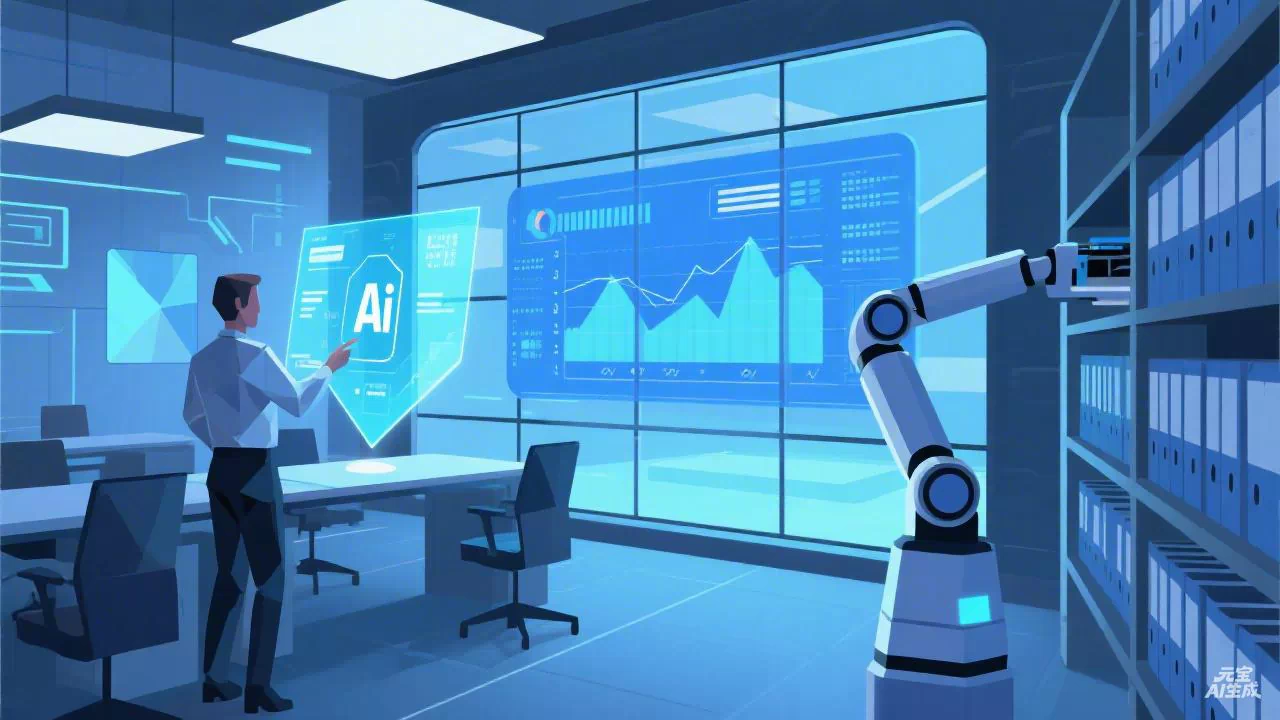
Leading the Future: AI-Driven Revolution in Enterprise Office Efficiency
1. Efficiency Bottlenecks and Challenges of Traditional Office Models
In an age of information overload, complex processes, and high collaboration costs, many companies face common dilemmas: employees spend more than 3 hours per day on repetitive administrative tasks; cross-department projects suffer delayed decisions due to information silos; knowledge and experience are scattered across personal computers and chat logs, making it hard to preserve and reuse. Traditional "stacking more people" and "patching processes" have hit an efficiency ceiling, while AI technology is opening new breakthrough opportunities for enterprises.
2. Threefold Transformation of Office Efficiency Enabled by AI
-
Process Automation, Liberating Human Resources
- Intelligent document processing: Through OCR and NLP technologies, automatically classify contracts and invoices, extract key information, and archive them, freeing finance and legal staff from manual data entry.
- RPA (Robotic Process Automation): Simulate human operations to automatically perform rule-based tasks such as cross-system data synchronization, report generation, and email replies, with an error rate below 0.1%.
- Case: A retail company deployed RPA to handle supply chain reconciliations, compressing what used to take 3 days of manual verification into 2 hours, saving over 5,000 work hours annually.
-
Intelligent Decision-Making to Improve Quality
- AI-assisted analysis: Sales teams can query in natural language like "East China region's high-margin product growth rate last month," and the system automatically generates visual charts and attribution analysis, replacing manual pivoting.
- Intelligent meeting assistant: Transcribes discussions in real time, automatically extracts decisions and to-dos, and assigns them to relevant personnel, improving meeting efficiency by 40%.
- Knowledge graph applications: Build a company-specific knowledge base; new employees can ask "historical versions of Client A's technical proposal" at any time and quickly obtain related cases and expert recommendations.
-
Networked Collaboration to Break Down Silos
- Intelligent scheduling and resource allocation: Based on project priority, employee skill load, and equipment status, dynamically optimize task assignments and meeting room bookings to reduce coordination waste.
- Real-time cross-language collaboration: AI translation enables multinational teams to communicate seamlessly during collaborative editing and instant messaging, eliminating language barriers.
- Personalized workflow reminders: Based on employee roles and habits, automatically push information flows like "today's to-dos," "project risk alerts," and "related policy updates," reducing missed information.
3. Implementation Path: Four Key Steps from Pilot to Systematization
- Diagnosis and planning: Prioritize selecting pilot scenarios that are "high-frequency, well-defined rules, and high pain point" (e.g., expense approvals, customer service ticket classification), and define ROI metrics.
- Tool selection and integration: Evaluate in-house development, procurement, or platform partnership models; ensure AI tools connect with existing OA, ERP, and CRM systems to avoid creating new "digital islands."
- Gradual rollout and training: Cultivate pilot users through "AI application workshops" and design new "human-machine collaboration" norms (e.g., humans review AI-recommended key clauses) to reduce transformation resistance.
- Iteration and governance: Establish AI performance monitoring mechanisms and ethical guidelines, regularly optimize models, and pay attention to data security and employee privacy protection.
4. Beyond Tools: Building an AI-Friendly Organizational Culture
Technology is easy to obtain; the difficulty in transformation lies in "people's minds." Enterprises need to:
- Leadership by example: Managers proactively use AI tools to analyze business data, conveying commitment to change.
- Tolerance and incentive mechanisms: Reward innovative AI application cases, allow trial-and-error, and include "human-machine collaboration efficiency" in performance evaluations.
- Skills upgrade programs: Provide "AI literacy" training that not only teaches how to use the tools but also guides employees to think about "how to let AI solve more complex problems for me."
5. Future Outlook: From "Efficiency Improvement" to "Model Reshaping"
The ultimate goal of AI office transformation is not simply "doing existing work faster," but triggering changes in management models and innovation logic. When employees are freed from repetitive labor, they can focus more on customer insights, creative ideation, and strategic thinking; organizations, leveraging AI, can sense market changes in real time and achieve dynamic resource allocation and agile innovation. Embracing AI is essentially embracing a smarter, more human-centric future of work — where tools handle "execution" and humans focus on "creation."


